
Construction as courtship
Pufferfish mating!

So imagine you’re just swimming along, minding your own business, down on the seafloor.
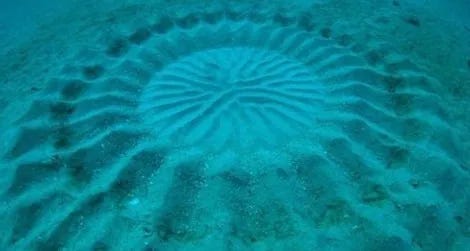
And then you see this:
Woah!
That’s...a lot of effort. Someone spent over a week making that. They carved every single one of those ridges by hand (well, by fin) working day and night, pushing sand grain by grain into concentric rings of geometric perfection. The whole thing is about seven feet across. The guy who made it? Only five inches long. That’s like if you were to build a 200-foot sculpture with just your face.
And honestly? You’re kind of into it.
You swim a little closer. You notice the center. There’s this intricate maze pattern down there, filled with the finest, softest sand you’ve ever seen. The coarser stuff got pushed to the outer ridges. Shells and bits of coral decorate the peaks, catching the light. The whole structure is channeling the ocean current around the center, creating this calm little pocket of fresh, oxygenated water. Whoever built this is saying: I’m strong enough to work for nine days straight, smart enough to engineer water flow, and meticulous enough to sort sand by grain size. For you.
He emerges from behind a ridge and starts kicking up sand in the center; showing off how fine it is, how much he’s gathered. Then he darts toward you, retreats. Darts again, retreats. It’s a little dorky, honestly. But it’s working.
You’re a female white-spotted pufferfish, and you might have just found the one.
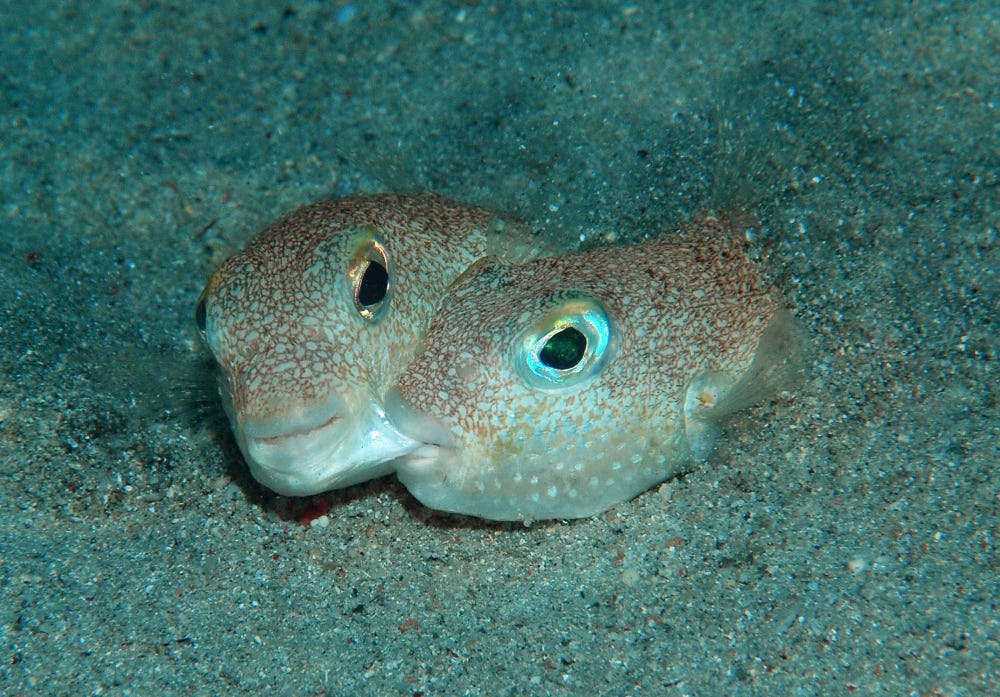
In 1995, divers off Japan’s Ryukyu archipelago noticed something extraordinary on the seabed: geometric circular patterns roughly two meters across. They called them “mystery circles.” It took 16 years for a team in Chiba identify the architect: a small, nondescript pufferfish later formally described as Torquigener albomaculosus.
The pufferfish researchers really dove deep. Early observations suggested that the more ridges a circle contained, the more likely a female would mate with the male; presumably because the puffer worked harder. Larger males also push sand farther, producing wider peak spacing. Others simply claim that female puffers care about nothing other than the fine sand in the middle, and “the beautiful lines and structure could serve only to channel those particles to the center, and have no aesthetic purpose.”
Whatever the reason, once the female puffer is drawn in, she’ll lay her eggs right at the middle, on that fine sand, and swim off. The male, after fertilizing the eggs, will stay around to guard; for the 6 or 7 days it takes for the fish to hatch. Afterwards, he too swims off; each circle is used precisely once.
A bunch of animals build something to attract a mate. Bowerbirds build huge bowers and even plant flowers. Cichlid fish suck up and spit out sand; building “sandcastles” underwater to attract mates, and intimidate rivals. Humans spend years building careers to improve their odds in sexual selection. But I think the puffers have got it figured out.
A week to build for fatherhood; a week to execute fatherhood, and he’s off into the open ocean. What a life.