
Solving the NYC housing crisis
with gratuitous overengineering

This week, I had a coffee in Elizabeth Street Garden; a fairly lovely little plot of land in lower Manhattan. And while there, I read about the legal battle between Haven Green (a group of developers who want to turn the garden into 126 units of affordable senior housing) and the Friends of Elizabeth Street Garden (people who like the garden).
That’s been raging since 2016. For 126 units. Meanwhile, we’re about 500,000 units of a “healthy housing market.”
Color me unimpressed. What would, like, ACTUALLY solving this problem look like? Tearing out Central Park? Cmon.
I’ve been on a megaengineering binge recently - so, for those of you who are delightfully curious; here’s more than you ever wanted to know about how we tried to solve the NYC housing crisis, via gratuitous overengineering.
1916: What if we paved over the East River?
At the start of the 20th Century, people dreamed BIG.
Kennard Thomson was a Canadian-American engineer. And he had some cred. He'd designed pneumatic caissons supporting dozens of Manhattan's skyscrapers. And he realized that Manhattan was simply too full. Indeed, aghast, he witnessed new New Yorkers engaging in the March Uptown; living (gasp!) north of 117th street. So here was his big dream:
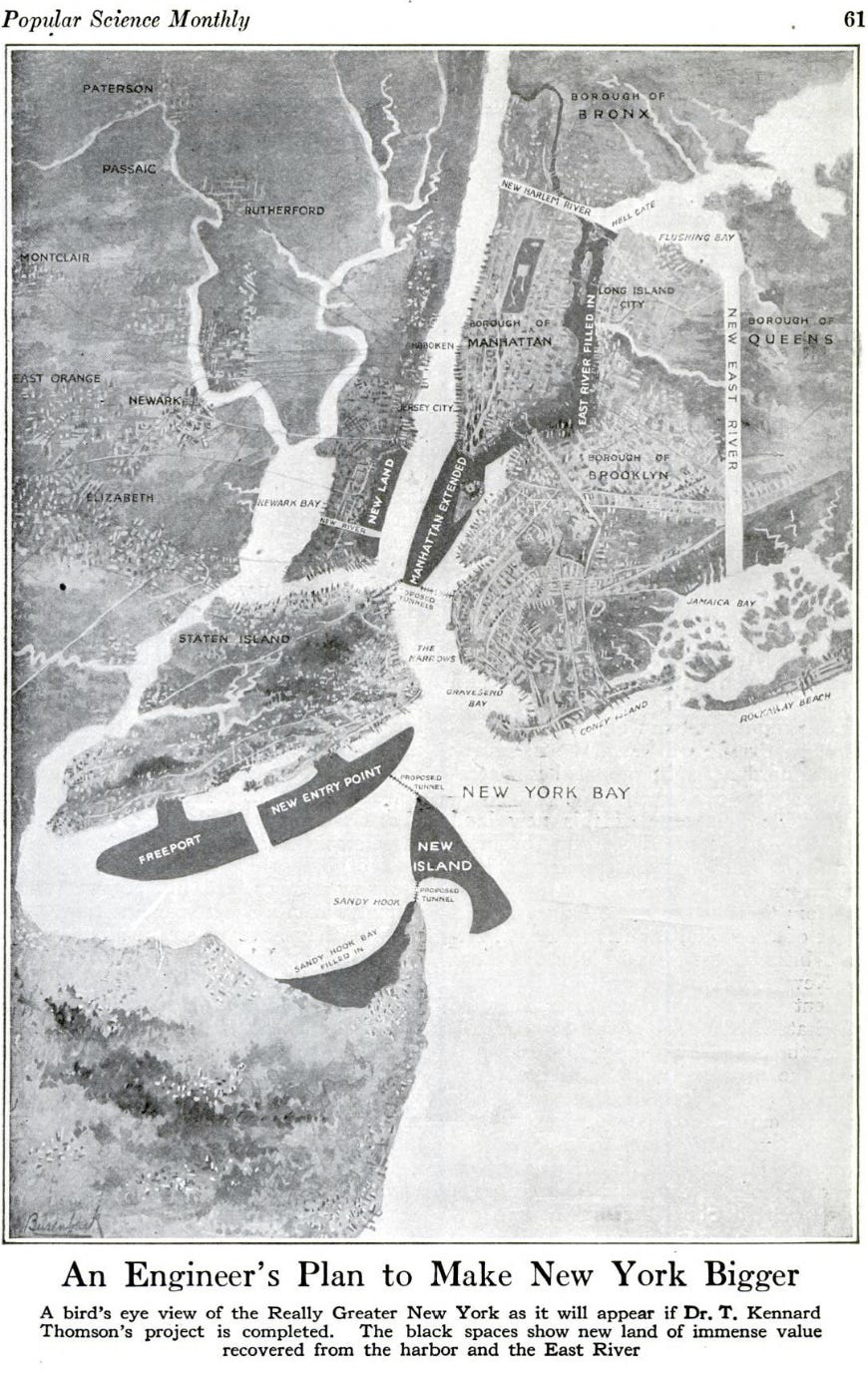
Fill in the entire East River. Oh, and while we're at it, extend Manhattan eight miles south into the harbor, add 50 square miles of new land, and create 100 miles of fresh waterfront.
It would’ve cost more than the Panama Canal, but, as he argued, would quickly make back its money given the immense value of Manhattan real estate. Here’s some of my favorite lines from that Popular Science article:
New York’s overflow has made of Brooklyn a great city.
Today, that’s Jersey; Brooklyn is simply NYC extended.
New York’s City Hall would become the center of a really greater New York, having a radius of twenty-five miles, and within that circle there would be ample room for a population of twenty-five millions.
We’re currently at 20 million in all of NY state. Housing crisis solved.
Proximity and easy access to the new Battery would increase the total land value of Staten Island from $50 million to $500 million. This would help pay the expenses of the project.
Woah, Staten Island actually good??
Of course, it didn’t happen. Thomson's fatal mistake? Allocating three square miles of his new land to New Jersey. And, of course, financing irregularities, and also that little thing called the Great Depression. Oh well.
Manhattan is already 25% fake
I’m talking about the land, not the people (that’s a bit higher).
Manhattan expansion isn't some wild engineering fantasy; it’s the status quo. By some estimates, over 25% of the island is man-made; wrenched from the ocean.
When the Dutch (famously good at getting land out of ocean) first came, they started draining and dredging. They had a “water lots” system: the 1686 Dongan Charter sold private developers underwater land, requiring them to fill and develop these areas. By the 19th century, New York was pouring all of its trash into the sea; we added 137 acres of landfill (and destroyed our oyster beds in the process).
Our biggest project was Battery Park City (formerly Battery Park Ocean). Between 1966-1976, the renovation project filled in 92 acres of new Hudson River land; much of it with soil and rock excavated during the construction of the World Trade Center.
2022: New Manhatta
Jason Barr, a Rutgers economics professor, is today’s Kennard Thomson. He wants to add a quarter million more New Yorkers, and protect Manhattan from storm surges, by building New Manhatta - an idea he pitched in the NYT.
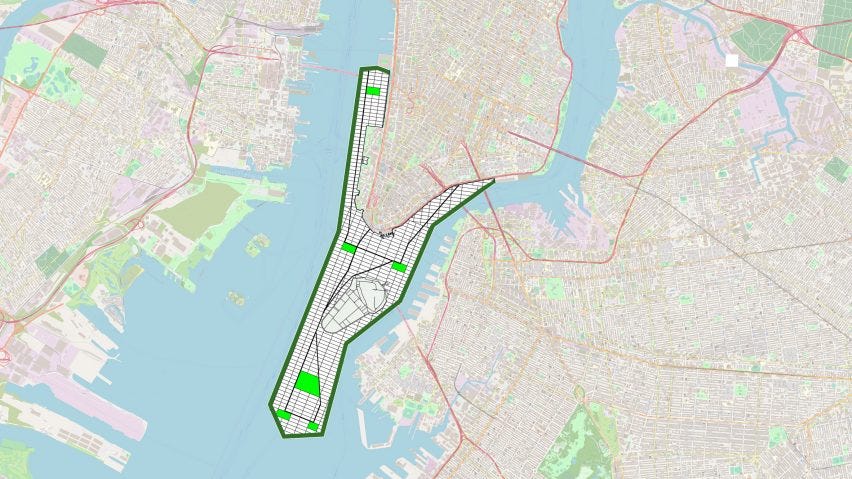
That map contains 1760 acres of reclaimed land, gained from adding 2.5 miles to the south tip of Manhattan. We’d get 180,000 housing units (still not halfway to solving the housing crisis) and also a much shorter Ikea ferry ride.
Barr estimates $34 billion in construction costs, but $240 billion in potential building value. He argues Manhatta could generate $1.4 billion in annual real estate taxes; about the same as the entire UWS.
But, frankly, I’m quite skeptical. We’re taking 10 years to figure out if we can pave over a park or not. Regulation has increased exponentially since 1916; especially in NYC. So too have costs.
Like take our current megaengineering project. Hurricane Sandy hit Manhattan like a truck…in 2012. In 2022, the US Army Corps finished their feasibility study, and suggested we break ground on the following plan:
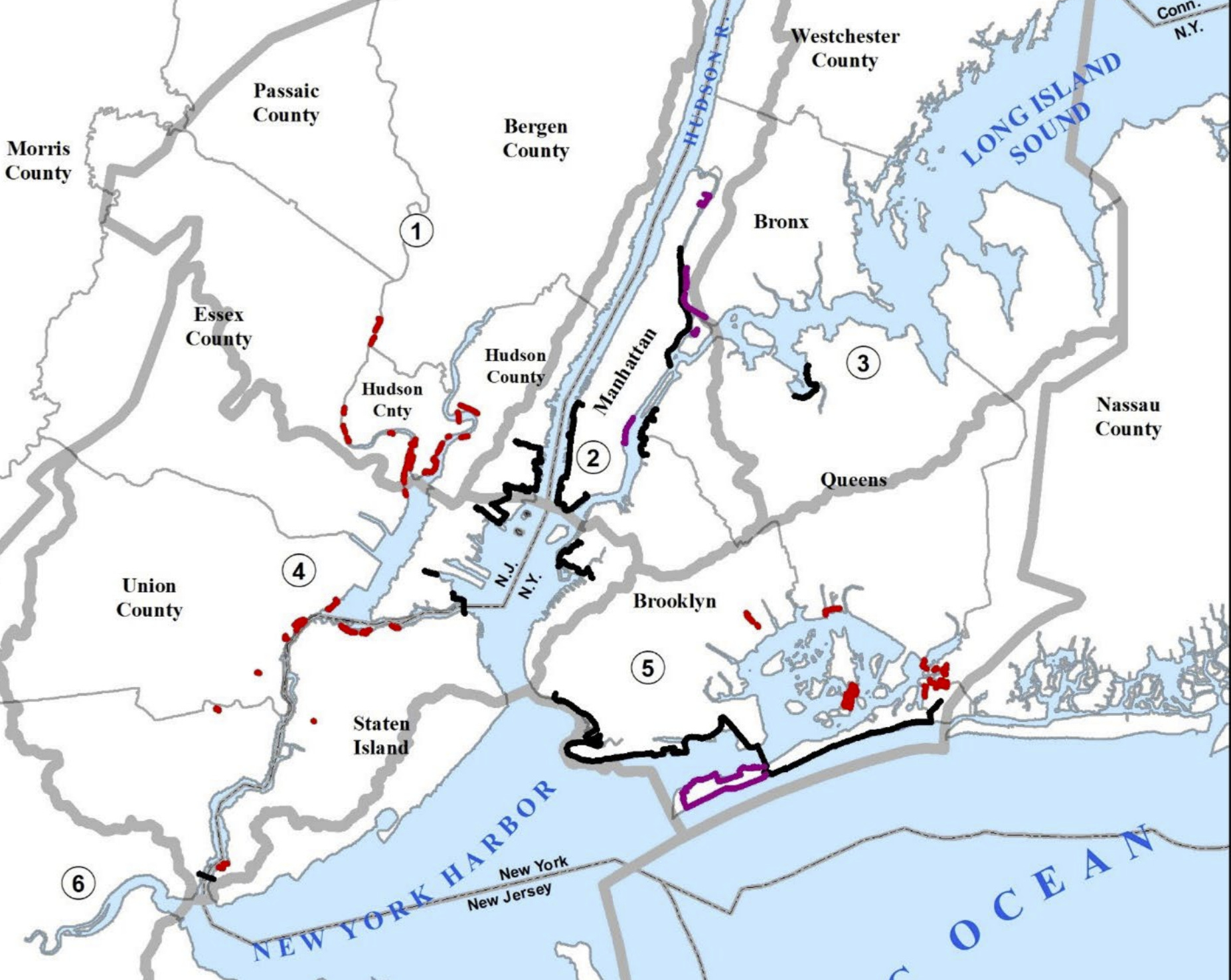
A couple of walls. To hold back global warming. 14 years of expected construction. At a base price estimate (so half the eventual price) of $52 billion.
Look, the housing crisis is crazy, and housing needs are real. The insane price of real estate in NYC can probably finance all manner of megaengineering projects. But if it takes 10 years to figure out whether we can build over a park, and where to build a couple walls after a hurricane, well.
Better learn how to swim.