
The Aldi-equator
Chopping the world in two

Aldi is basically European Costco.
There’s one a couple blocks from my current place; and it, like every other Aldi I’ve stepped into is set up the exact same way. One single snaking path through the whole store; one-way only. Pretty sparse product selection, but within that catalogue, everything is fiendishly cheap. Aldi is, go in, do your business, and get out.
The Aldi that I go to, however, is actually one-of-two; it’s actually Aldi Sud; or Aldi South. You’ve probably been to Aldi North as well. In America, it’s called Trader Joe’s.
Both Aldis are two completely separate, multi-billion-dollar companies. They have different owners, different logos, different product lines. And between them, they’ve split the world in half.
The Brothers Albrecht
Our story starts in 1913, when Mrs. Albrecht opens a small grocery store in Essen, Germany. Her two sons, Karl and Theo, help out in the shop from boyhood. Both go off to fight for Nazi Germany in WWII; both come home, and in 1946 they take over the family store.
There, they invent the modern no-frills supermarket. Limited selection, fast checkout, and self-service. No advertising, no decorations, no fresh produce; products sold straight out of cardboard boxes. It works really, really, well. By 1960 they have 300 stores, incorporated under the name Aldi; short for Albrecht-Diskont - i.e. Albrecht Discount.
But by 1960, the brothers have a lot of beef. Different management styles have put them at odds for quite a while. It all comes to a head when they decide whether they should sell cigarettes. Theo thought it’d make a big buck, while Karl thought smokers were shoplifters, and putting cigarettes in would cost them more than they earn. At that point, they decided to settle the problem in the most mature way possible - they took a map of Germany, drew a line, and went no contact.
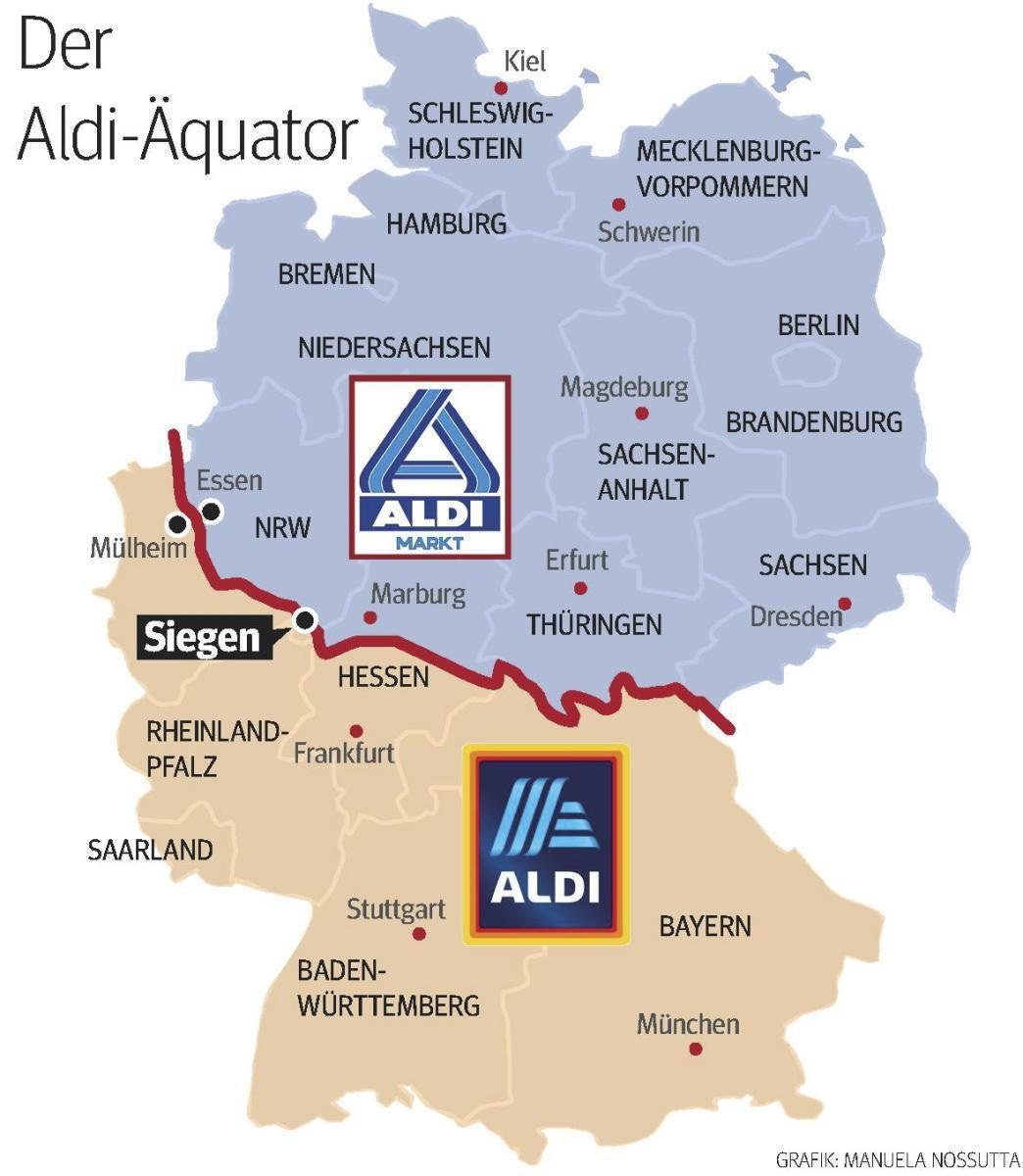
The Aldi-Äquator (yes, that’s its actual name: Aldi Equator) runs from west to east. Theo got Aldi Nord; Hamburg and Berlin. Karl got Aldi Sud, with Frankfurt and Munich. They set the line right through the middle of their hometown of Essen, presumably so their mum can tell them which son is her favorite based on her weekly purchases.
(What’s up with Germans and putting walls in the middle of cities? Oops…I shouldn’t say that).
The Two Aldis
Both halves start conquering the world, careful never to step on each other’s toes.
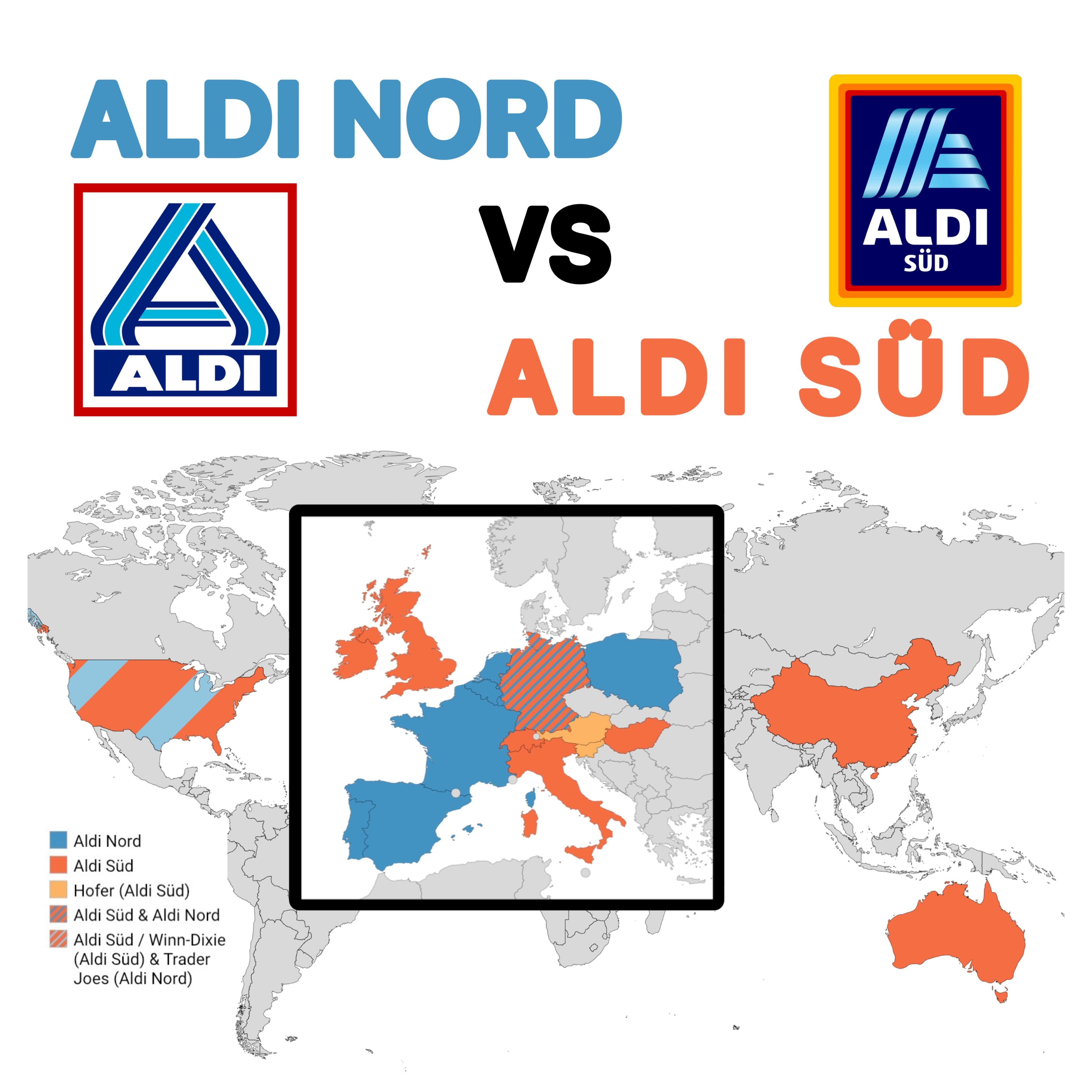
Aldi Süd (Karl, no cigarettes) goes to Austria in 1967, then takes the UK, Ireland, Australia, Italy, and China. Meanwhile, Aldi Nord (Theo) takes Spain, Portugal, France, the Netherlands, Poland, and Belgium. It’s a gentlemanly agreement to avoid confusing consumers; after all, they both are called Aldi and have pretty similar logos. It also helps the two chains avoid competition (wee-woo wee-woo cartel??).
In 1976, Karl opens his first US store in Iowa. This is the Aldi you recognize; the one with the quarter-deposit shopping carts and one-way grocery layouts. Three years later, Theo wants in on American action. “Aldis” is already taken, so he buys a quirky California grocery chain called Trader Joe’s, and starts growing it nationwide.
Thus, for the last 50 years, these two empires have coexisted, never overlapping, except in the United States…where they sit in adjacent strip malls and pretend not to see each other.
Now Today
As of 2025, the Heister family (Aldi Süd) and the Albrecht family (Aldi Nord) are reportedly negotiating a merger of the two Aldis. Combined, they’d operate ~12,000 stores worldwide with annual sales of around €115 billion per year.
After 65 years of separation, the cigarette divorce might be ending. These days, of course, neither Aldi nor Trader Joe’s sells cigarettes. The original fight is moot. But it was never really about that; it was abut two brothers who couldn’t get along, chopped a world in half, and left their estates to try to glue it back together.
Random fun fact that doesn’t really have to do with this post: In 1971, Theo is kidnapped on his way to work. His captors are a lawyer with crippling gambling debts, and a convicted burglar. They keep Theo locked in a wardrobe in Düsseldorf for 17 days. Eventually, the Catholic Bishop of Essen walks a duffel bag of cash ($7M Deutschmarks, around $2M USD back then) to free a billionaire from a wardrobe.
Theo, ever the businessman, later tries to claim the ransom as a tax-deductible business expense. The court says no.